When the village gets older
When buying real estate in Italy, many buyers’ attention initially goes to visible factors. The location seems idyllic, the house has character, and the price looks attractive compared to other countries. What often goes unnoticed is an aspect that is at least as defining in the long term as architecture or square footage: the demographic structure of the place.
Italy has been undergoing profound demographic change for decades. The population is aging, young people are leaving rural areas, and entire villages are steadily losing inhabitants. This process is slow but constant. For property buyers, this means when you buy today, you are not just buying a house, but also an environment whose development is already foreseeable. The demographic context determines how everyday life, infrastructure, social dynamics, and the long-term usability of a property will develop. A beautiful house can lose value if its surroundings shrink. Conversely, a simple house can gain importance if it is in a functioning social space.
Italy as an aging society – regional differences
Italy counts among the countries with the highest life expectancy in Europe and at the same time among those with the lowest birth rates. This combination leads to a continuous shift in the age structure. However, this process does not affect all regions equally. Large cities, university locations, and economically active regions continue to attract young people. Rural areas, on the other hand, lose population. Mountain areas, remote inland regions, and towns without economic prospects for younger generations are particularly affected.
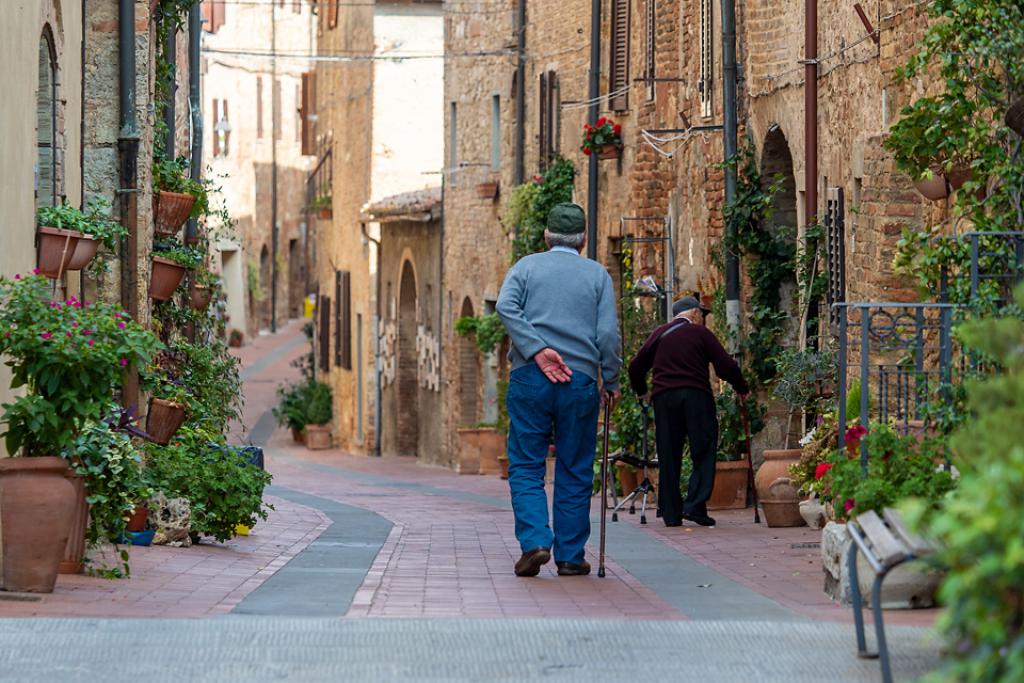
In some municipalities, the average age is well over 60. The share of people over 75 is growing, while children and adolescents are hardly present. Schools close, kindergartens are merged, and clubs disband. This development is not a sudden event, but a creeping process that sustainably changes life on the ground.
For property buyers, it is crucial to understand that this change is not an exception, but the norm in many parts of Italy.
What demographic change specifically means in everyday life
Demographic change shows itself not only in statistics but in daily life. Those who buy property in a rapidly aging village experience changes that go far beyond peace and idyll. Shops close because there are no successors. Opening hours are shortened, services are reduced. Public transport runs less often or is discontinued altogether. Medical practices find no successors; pharmacies serve larger areas. Administrative matters increasingly require trips to larger towns. At the same time, the social fabric changes. Neighbourly help becomes more important because formal structures are missing. Contacts arise more slowly but are often more enduring. Traditions are maintained; changes are viewed cautiously. This reality can be experienced as a limitation or as quality.
What matters is not whether a place is aging, but whether this way of life fits one’s own life phase.
Infrastructure as a mirror of population development
Infrastructure is one of the most visible indicators of demographic development. Where the population shrinks and ages, the range of services inevitably changes. For property buyers, it is therefore important not only to look at the current state but to recognize development trends. An existing supermarket says little about the supply situation in five or ten years. A school in operation does not guarantee its continuation. Medical care can quickly centralize if demand falls or specialists are lacking. At the same time, new forms of organization emerge. Mobile services, community solutions, and informal networks partly compensate for the withdrawal of institutional offerings. These structures work well if social bonds are strong — but they require initiative. Anyone buying a property should ask themselves how dependent they are on external infrastructure and how flexibly they can respond to changes.
Who might find aging villages attractive
Aging regions are not fundamentally problematic. They are simply not suitable for every buyer group. Their attractiveness depends heavily on individual needs, life phase, and expectations. Such places are particularly suitable for people who seek peace, stability, and retreat. Retirees, self‑employed people with high location independence, or buyers who consciously want to distance themselves from urban structures often find exactly what they are looking for here. Aging villages are less suitable for families with school‑age children, people with strong professional commitments, or buyers who depend on social dynamics and diverse offerings. The property itself is rarely the problem. Difficulties usually arise from a misjudgement of the surroundings.
Property value beyond classic market logic
In aging regions, different standards of value apply. Classic appreciation through rising demand is rare. Real estate markets are illiquid, and sales processes often take a long time. Price stability is more likely than growth. For buyers, this means the financial aspect needs re-evaluation. The value of a property lies less in its market price than in its usability. A house that costs little but incurs high ongoing costs can be more burdensome in the long term than a more expensive property in a functioning environment. Many buyers underestimate the influence of the surroundings on property value. A house loses its attractiveness not only through physical decay but also through the loss of social and infrastructural ties.
Aging villages and emotional expectations
A common motive for buying in rural regions is the longing for community. Small places are associated with closeness, familiarity, and cohesion. These expectations are not wrong, but they are not automatically fulfilled. In aging villages, social structures are often established and closed. Newcomers are welcomed kindly but remain observers for a long time. Integration takes time, patience, and willingness to adapt. Language skills, presence, and respect for local customs are crucial. Those who expect to become part of a lively community immediately will be disappointed. Those willing to integrate slowly often find stable, reliable relationships.
Opportunities in regions with demographic change
Despite all challenges, aging regions also offer opportunities. Vacancies lead to moderate prices, and funding programs support renovation and revitalization. International buyers bring new perspectives and impulses. In some regions, new residential models, community projects, or cultural initiatives are emerging. These developments progress slowly and are not visible everywhere, but they do exist. For buyers who think long‑term and want to be actively involved, such regions can be a consciously chosen living space — not despite, but because of their structure.
Importance of realistic planning
Buying real estate in an aging village requires realistic planning. This includes honestly addressing questions of mobility, supply, health, and social integration. Those who consider these aspects beforehand avoid later disappointments. It is also important to distinguish between holiday use and permanent residence. What seems idyllic for a few weeks a year can be burdensome in everyday life. Conversely, a quiet place can be ideal for everyday life, even if it appears unspectacular to visitors.
Long‑Term perspective instead of snapshot
Many buying decisions are based on snapshots. A sunny day, a friendly conversation, a quiet environment. These impressions are valuable, but they do not replace a long‑term perspective. Demographic development is predictable. Population figures, age structure, and infrastructure can be analysed. Those who use this information make more conscious decisions. A house often stands for decades. Its surroundings change. Those who consider this buy more sustainably.
Conclusion: not every village must grow — but every village must fit
Demographic change is a reality that property buyers in Italy should not ignore. It is neither a reason to reject nor a reason to buy but a contextual factor that must be understood. An aging village can be an ideal place — for the right people, at the right time, with the right expectations. A young environment is no guarantee of quality of life, and an old one is no obstacle. What matters is the fit between property, surroundings, and life reality.
Those who take this fit seriously make better decisions — and live more happily in the long term.